
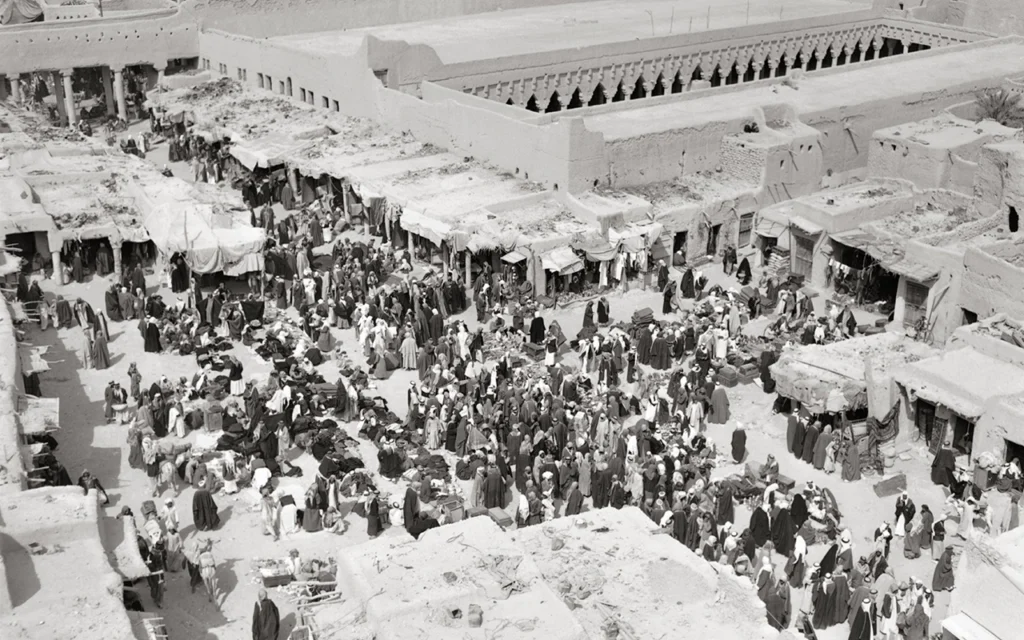
The history of the Kingdom of Saudi Arabia is linked to the Arabian Peninsula, as the Kingdom constitutes its largest segment. It has emerged as the region’s predominant force, civilization, and leadership after the Islamic State and the Rashidun Caliphate, rendering it the most significant historical transition in the Arab region for centuries.
The modern history of Saudi Arabia began with the establishment of Diriyah in 1446 by the ancestor of the House of Saud, Mani bin Rabiah al-Muraidi. This establishment continued until the reign of Imam Muhammad bin Saud, who elevated Diriyah from a city-state to the capital of the vast state, marking the formation of the first Saudi state in 1727. With the end of the first Saudi state in 1818, the second Saudi state was reestablished by Imam Turki bin Abdullah bin Muhammad bin Saud in 1824. With the end of the second Saudi state in 1891, the Saudi State was reinstated for the third time by King Abdulaziz bin Abdulrahman bin Faisal bin Turki bin Abdullah bin Muhammad bin Saud, with the recovery of the capital, Riyadh, on January 15, 1902.
Unification of Saudi Arabia
It took over thirty years for Saudi Arabia to complete its third-phase unification, which involved bringing together all regions and cities. Commencing in 1902, the unification project culminated in the issuance of a royal decree on September 19, 1932, officially establishing the unified country as the Kingdom of Saudi Arabia. Since its inception, the state has emphasized spreading knowledge and education and attained political independence. The pace of the economy evolved rapidly, and this was reinforced by the extractionof oil and minerals.
hello. edit